
Putting the Strategic into Public Relations
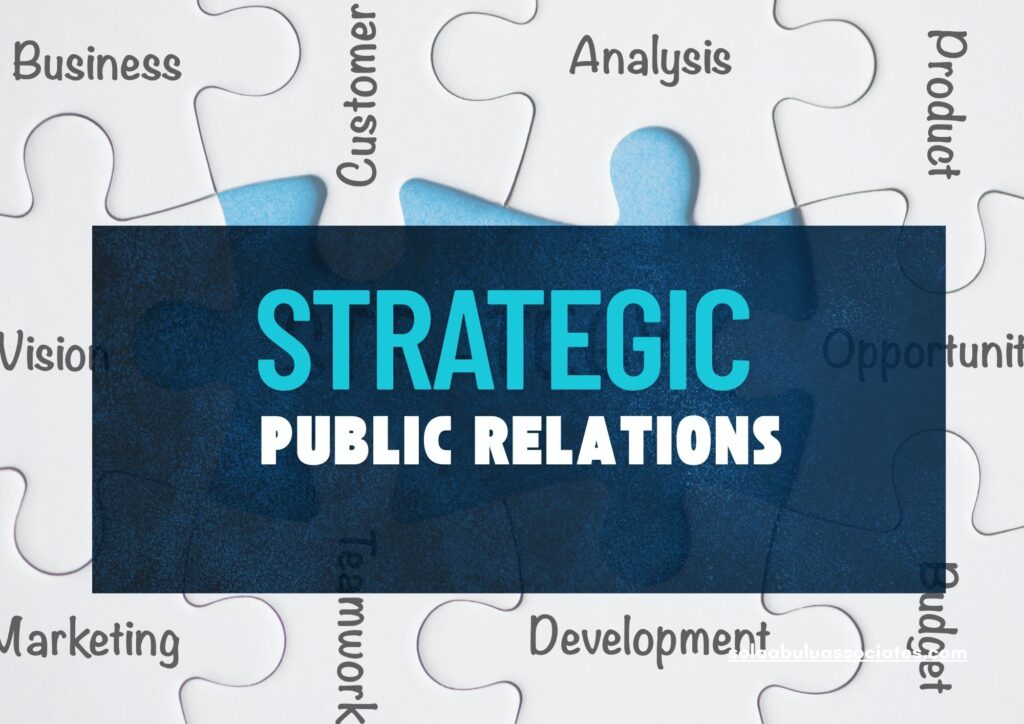
Public Relations is a practise that has been around for over a century. According to Wikipedia entries, The history of the profession is predates the 20th century and it was first used by governments to persuade or rally the people around a common objective. And then later used by business and high networth individuals to protect their interests in society and the economy at large.
The profession has therefore gone through several phases of evolution to become an extensive field today that is embraced as a necessary component of operations for every group, organization, community, agenda, initiative, business, brand, institution or entity.
Because of the constant evolution of the practise of Public Relations, it is difficult to find one definition that covers everything because PR is defined by the objectives of those who practise it. So what goes into your PR toolkit depends on your mission, values, perspective of the world, how you see your place in it, the expectations of those you seek to target and the dynamics at play within the context of the identified relationship.
With that in mind – a working definition for Public Relations is the way in which an organization, entity, brand or institution, interacts and interfaces with identified audiences, stakeholders, partners and interest groups in its eco-system and society to create space and support for the fulfilment of its mission. It is about how it seeks to create goodwill, earn a space in society and build collaborative alliances, recognition, visibility and a respected presence in the eco-system and in all identified community spaces that are relevant to its long-term interests.
Strategic Vs Traditional PR
What does it mean to implement Strategic Public Relations? It means to take a comprehensive approach that aligns all relationship building elements with a central objective of influencing behaviours, winning support, gaining acceptance, building relationships with identified stakeholders. It takes a very structured approach that leaves no room for failure. It is integrated and does not take a Let’s go with the flow approach. Every element of the strategic PR plan is pre-designed and detailed to move the needle from point A to B.
An example of how this is done – for instance is a Strategic PR plan for a new product launch would have to be tightly executed within a launch period cycle and every meeting, event, visit, messaging, publication must be timed to be deployed in sync with other elements running simultaneously.
Strategic PR would also be very tailored to specific audiences and not take a one-size-fits all approach as traditional PR would. It could deliver a very immersive experience that leverages on traditional and digitally-enabled methods of engagement. It is very focused on delivering the final outcome and would use a mix of PR and Communications methods to ensure that success is achieved.
Strategic PR Plan
A strategic PR plan would ask the following questions.
- Who are my stakeholders?
- Who is my audience?
- What are their expectations of us?
- What do we know about them?
- What do we want them to KNOW about us?
- How do we want them to FEEL about us? (i.e., sentiment and perception)
- What do we need them to DO? And how can we ethically, transparently, and effectively influence that action?
- How do we reach them?
- What is the message?
- How do we transmit the message?
- What does success look like in tangible and real-life terms ?
BUILDING CREDIBLE PR KPIs
A Strategic PR plan would also build credible key performance indicators. It is not enough to just host a meeting. The expected goals from the meeting would have been agreed with leaders before the time and everything about the meeting would have been pre-designed to ensure that we get what we want from the meeting. This would require extensive pre-meeting engagements to ensure that you get a sense of expectations from VIP guests as well as the convening leaders and you come up with a program that facilitates the process.
Everything has to be well set up to work towards this outcome. The choice of venue, the program elements, arrival time, protocol arrangements, reception, venue facilities, information provided for travel and logistics, meet and greet, event program. The pre- event, event proper and post-event elements must be tightly worked with due consideration for the interests, needs of the guests and key participants in the meeting. And you gather enough data and work with the teams of the guests to ensure that every detail runs to the greatest satisfaction and that you achieve the outcomes you want.
Strategic PR leaves no room for failure.
Questions to ask in developing Strategic PR Key Performance Indicators
- What is the objective of this relationship from your perspective
- What does success look like?
- How do I measure goodwill?
What should a PR campaign or initiative deliver?
– media buzz or publicity
– brand visibility and credibility
– relationships introduction
– 3rd party endorsement
-Signing of an agreement
PR operates behind the scenes in many ways that is not often obvious. For instance, if a football club wants to sign a new high valued football player and wants to invite him over to the club to see if he would like the new environment, a PR plan needs to be in place to host the footballer over the period because his or experience during that time would have a big impact on the decision to move country, and come with the family to live in another country and sign a contract for the next few years. So the PR team working on that visit must work with the football club closely to ensure that all goes well. Success would be that the footballer has a great time on the visit, expectations are exceeded etc
The strategic PR plan would focus on ensuring that the footballer KNOWs that he or she is a valued player that is very welcome in the club and would be well received by the team mates, captain, coach, management team and fans. It would also aim to provide all the information that would be necessary to move towards a positive decision. This would require extensive research into what matters to them and their personal values.
Ultimately, regardless of whether the footballer signs up or not, it should be clear that the decision not to sign the contract was not because of a fault in the reception. In fact if the PR plan is worked well, it would be obvious to everyone that it was a very difficult decision not to sign.
That is strategic Public Relations in practise.
You take nothing for granted. You script every little detail as you would for a movie or a TV production set.
KPIs should be based on real-life tangible outcomes and success criteria agreed with program sponsors. Success is not about hosting events but about impact and outcomes achieved in value terms. Return on investment is very important in strategic PR. Traditional PR tends to chalk everything up under goodwill. But strategic PR focuses on what is specific, measurable, achievable, realistic and time-bound (SMART).
Sola Abulu & Associates (SA&A) is a strategy and communications training and consulting firm dedicated to enabling businesses, brands and institutions to achieve their desired objectives through strategic communications, organizational effectiveness and reputation risk management.
Enrolment is ongoing for the Public Relations, Media & Stakeholder Management Course scheduled for July 31, 2025 from 9AM – 4PM West Africa Time via ZOOM.
Register here to join the session: https://www.solaabuluassociates.com/signup-interest/ or send us an email on training@solaabuluassociates.com