How To Apply Strategic Communications In The Development Sector & NGO World
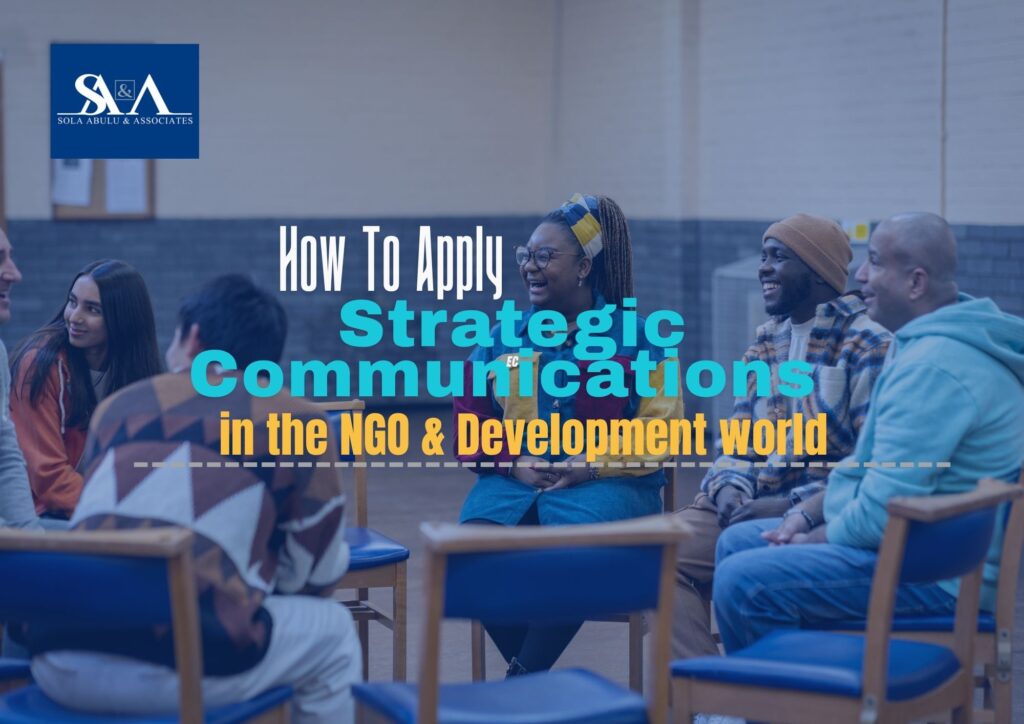
The concepts and principles of Strategic Communications are as applicable to the Development Sector as they are to private sector but in practise, it appears that the private sector makes better use of these concepts and there is more room for expanded use in the Development/NGO/Humanitarian/Faith-Based Sector.
Let’s take them one by one.
Internal Communications
Internal Communications is one area that could be more purposefully deployed in development organizations as a tool to build a shared vision; carry everyone along with the mission of the organization and ensure that all members of the team are aware of what is happenning in different aspects of the organization. Silo working is very common in development organizations and often office workers have very little input into what happens on the field. Some organizations are better than others but internal communications can be used to create a sense of belonging and keep everyone aligned with the mission. This is even more important in development contexts where compensation and benefits are relatively low compared with private sector and members of the team are on varying work contracts e.g. temporary, contract, permanent or volunteers. Building a team that is aligned through centralized communication strategy that is two-way and interactive is key.
Impact Storytelling
This is an important aspect of communications that plays a huge role in the success of development organizations. The ability to tell and show the impact of your contribution to society or fulfilment of your purpose is directly proportional to the ability to attract investment/donor interest; volunteers and public and private sector partnerships. Unfortunately most development organizations do not fully leverage on the opportunities of investing proactively in creative impact storytelling. The ability to tell a compelling story in the development sector would require a through application of the strategic communications framework – working through a step by step analysis to determine who the audience and stakeholders are and the required message, platform and content strategy to get the required attention and action.
Brand Strategy & Communications
Another big opportunity area is in Brand Strategy and Communications. It is important that NGOs invest in their Brand and communicate proactively about it’s role and contribution – so that the audience and general public can attribute their activities and connect the dots around their overall impact. Brand building for an NGO must be as purposeful and intentional as it is for private sector companies because this helps to create space and support for the activities of the organization and opens doors for wider impact. Although there are some NGOs who are quite good at brand communications, the sector is currently way behind other sectors in terms of the use and practise of strategic communications targeted at the external world. There seems to be more focus on communications centred within the development world i.e. to community leaders; partners, program officers, government etc.
The concept of corporate brand reputation is only sparingly used in NGOs and this makes them vulnerable in times of crisis as very few people outside the “impact bubble” understand or know what the NGO really does and how it operates. It is striking to note that the Edelman Trust Barometer notes that globally, businesses are more trusted than NGOs. It is safe to assume that this is not necessarily because Business is more ethical than NGOs but due to the fact that it communicates much more proactively and uses modern communications strategies and tactics to achieve its objectives
Stakeholder Engagement
Stakeholder engagement is probably one area that NGOs handle quite well. It is an important element of development interventions. It is impossible to conduct any form of development work in any context without engaging with stakeholders in different spaces e.g. community, government, media, program partners, donors, opinion leaders and social activists or influencers in some cases. However, most NGOs only use the Stakeholder Management process to conduct the development interventions and do not use this same process to develop a communications strategy that amplifies their impact or helps them to create or expand their social and societal capital in the areas where the operate.
Issues & Crisis Communications
This is also one area where there is room for improvement in terms of development communications. Majority of NGOs are ill-prepared for communicating in crisis that is targeted at them negatively. They are more familiar with Risk or Disaster Communications which is designed to help vulnerable populations facing different types of health, humanitarian, social or environmental or conflict-related crisis. It is a form of communications that is designed to help others. However, issues and crisis communications is focused on helping the NGO navigate a situation when its own activities are the target of negative sentiment or an existential crisis. This is a scenario that many NGOs are unprepared for because they tend to believe they are a force for good and things like that are not likely to happen to them.
SA&A is a strategy and communications consulting and training firm dedicated to enabling businesses, brands and organizations to achieve their desired objectives through strategic communications, organizational effectiveness and reputation management.
Join us in class on November 27, 2025 for our last online ZOOM full day course on Strategic Communications from 9Am – 4PM WAT.
PLAY-ON-DEMAND COURSES
Learn with us 24/7 on learn.solaabuluassociates.com
The following courses are available and accessible 24/7 on our e-learning platform as follows:
- SA&A CPDSO-Accredited Strategic Communications Course
- SA&A CPDSO-Accredited Issues, Crisis & Reputation Management Course
- SA&A CPDSO-Accredited Brand Strategy & Marketing Communications Course
- SA&A CPDSO- Accredited Public Sector, Policy & Political Communications Course
*Our Play-On-Demand Courses are accessible 24/7 and payment can be made in Nigerian Naira or US Dollars. Please click on any of the links above. Course curriculum is accessible for 6 weeks after payment. Course certificate is issued after completion of the course via email by training@solaabuluassociates.